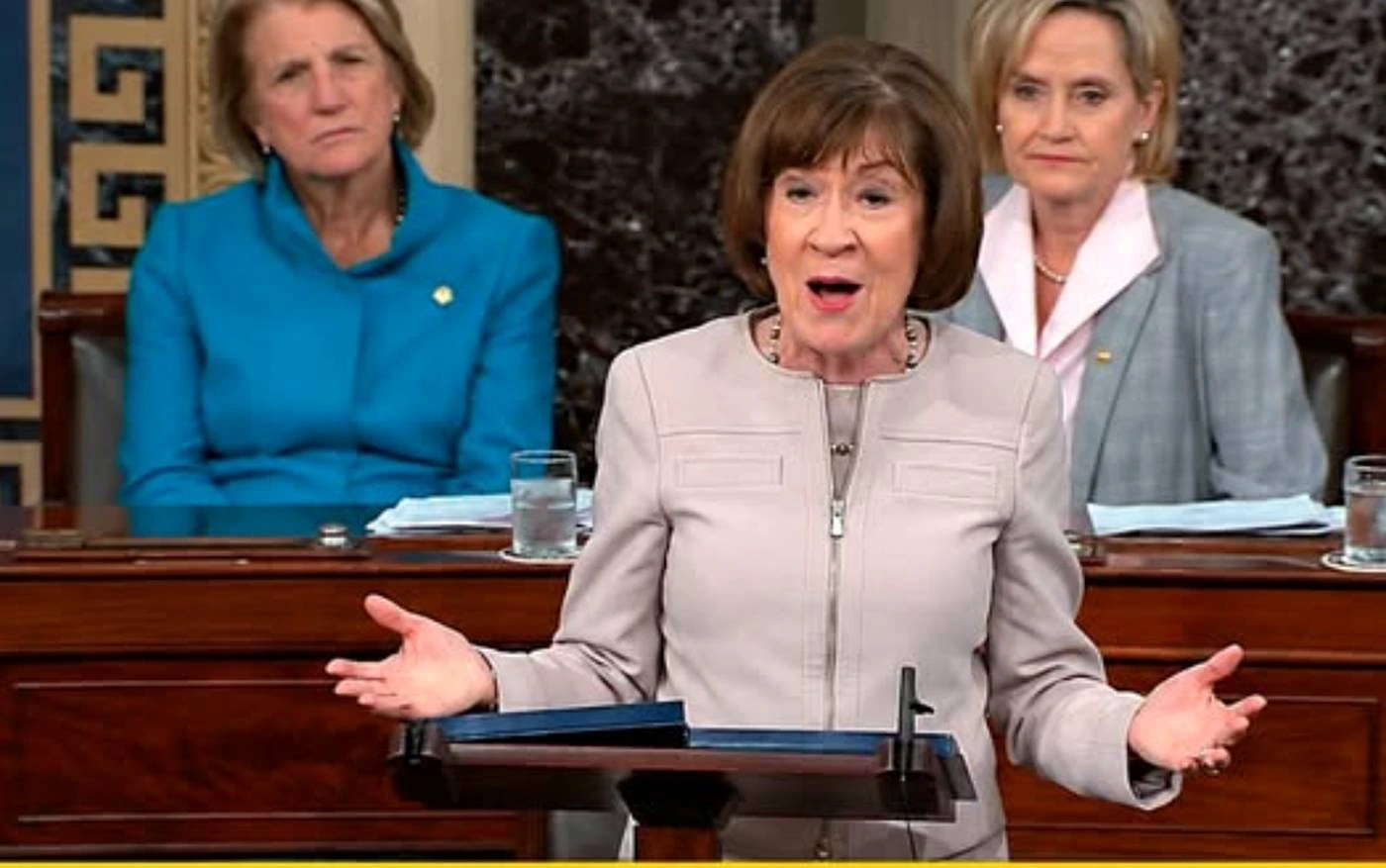
Maine Republican Sen. Susan Collins broke ranks with Senate GOP leadership this week, joining Democrats in a high-stakes procedural vote that could have derailed a major Republican-backed budget package.
Collins supported a Democratic motion introduced by Sen. Jon Ossoff (D-Ga.) to send the Senate’s $70 billion budget reconciliation legislation back to the Judiciary Committee for additional review. The motion called for an investigation into allegations that insurance companies have improperly denied or delayed medically necessary treatment and coverage for patients.
“Let’s ban insurance companies from denying or delaying medically necessary healthcare to Americans,” Ossoff declared on the Senate floor.
To make his case, Ossoff described the experience of a constituent diagnosed with multiple myeloma, a rare form of blood cancer, who reportedly struggled to obtain insurance coverage for necessary medical treatment.
He argued that patients across the country continue to face similar obstacles when insurance providers refuse or delay access to essential healthcare.
Collins was one of the few Republicans willing to support the Democratic effort. However, unlike an earlier vote in April, when Republican Sens. Dan Sullivan of Alaska and Josh Hawley of Missouri also supported a similar proposal, both senators voted against the latest motion.
Had Ossoff’s motion succeeded, it could have seriously jeopardized the reconciliation package, which includes billions of dollars in funding for Immigration and Customs Enforcement and Border Patrol through 2029.
The vote comes amid a major political transition for Collins, who recently conceded her reelection race to Democrat Troy Jackson, ending a Senate career that began in 1996.
“It has been the honor of my life to serve the people of Maine in the United States Senate,” Collins said, confirming that she had contacted Jackson to congratulate him and pledged to help facilitate a smooth transition.
Her departure represents a significant loss for Senate Republicans, particularly because she chaired the powerful Senate Appropriations Committee, which plays a central role in determining federal government spending.
Collins had repeatedly emphasized that her seniority and committee leadership allowed her to secure important resources and deliver results for Maine.
Her successor, Jackson, is a fifth-generation logger and former Maine Senate president who built his campaign around working-class voters, organized labor, and rural communities.
“Maine, I owe you everything,” Jackson wrote on X following his projected victory, promising to remain connected to the people and communities that shaped his political career.
Jackson’s road to the Senate was far from straightforward. He replaced Democratic nominee Graham Platner after Platner withdrew from the race in July amid sexual-assault allegations. The Maine Democratic Party subsequently selected Jackson as his replacement.
His campaign also faced personal controversy following reports concerning his relationship with his partner, who is also his second cousin. The reports stated that the couple share great-grandparents, creating another challenge during an already compressed campaign.
Nevertheless, Jackson ultimately secured the victory, defeating a Republican incumbent who had served Maine in Washington for nearly three decades.
Collins’ break with Republican leadership on the healthcare motion highlights the complicated political dynamics surrounding the final months of her Senate tenure, while her departure marks the end of one of Maine’s longest-serving congressional careers.