President Donald Trump has issued one of his strongest warnings yet to Cuba’s communist government, declaring that he wants to resolve the situation on the island before leaving the White House and refusing to rule out military action if necessary.
During a Thursday interview with conservative radio host Hugh Hewitt, Trump was asked whether he would consider authorizing military force to help free Cuba before the end of his presidency.
His response was direct.
“I want to get Cuba done before I leave,” Trump said.
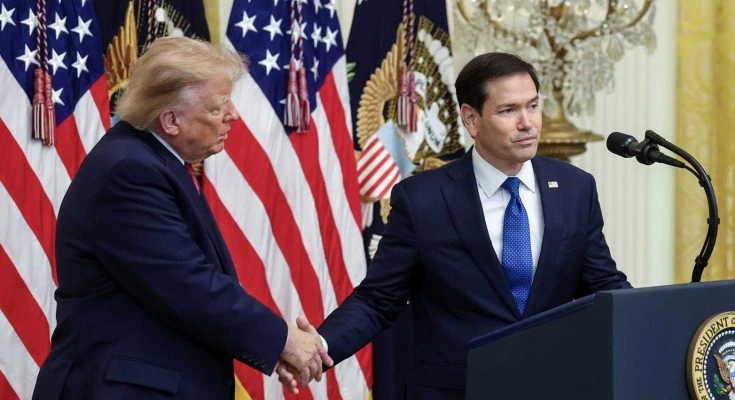
The president also pointed to Secretary of State Marco Rubio as a key figure in his administration’s approach to Cuba, highlighting Rubio’s personal family connection to the island.
“And we have a very good, talented guy for Cuba named Marco,” Trump said.
“Because Marco’s parents are from, Marco Rubio, his parents are from Cuba as you probably know. And he would love to do that.”
Trump described Cuba as a country facing serious economic and political difficulties, adding that his administration is monitoring developments closely.
“So we’re watching it very closely,” Trump said. “It’s doing very poorly. It’s essentially a failed, you know, place, nation, whatever you want to call it.”
“It’s failed. And we’re watching it.”
The conversation became more significant when Hewitt directly asked whether Trump would accept a limited military campaign if that became necessary to achieve his objectives.
“So if it took a little bit of military force, a week campaign, you’d be okay with that?” Hewitt asked.
“I would certainly consider that, yes,” Trump responded.
Although Trump did not announce military action or provide an operational timetable, his answer made clear that the administration has not excluded force from its potential options.
The president also framed his position around Cuban Americans who fled the communist government and rebuilt their lives in the United States.
“I’d love to be able to do it for the people, for the Cubans that came and were treated really badly, and they came to America,” Trump said.
His comments come as Washington continues escalating economic and diplomatic pressure on Havana.
Earlier this year, Trump declared Cuba an “unusual and extraordinary threat” to U.S. national security and threatened tariffs against countries supplying oil to the island.
His administration has also expanded sanctions targeting Cuban government officials and entities connected to the military and energy sectors.
Meanwhile, Cuba continues struggling with severe fuel shortages, widespread power outages and a deepening economic crisis under President Miguel Díaz-Canel.
Trump has repeatedly suggested that the communist government is approaching a breaking point. Earlier this week, he predicted that Cuba “will fall fairly soon” and raised the possibility of American humanitarian assistance for the Cuban people.
Havana has strongly rejected Washington’s approach, accusing the United States of attempting to economically suffocate the island and force regime change. Cuban officials have also insisted that the country would defend itself against any military intervention.
Rubio could play a particularly important role in the administration’s next steps. His parents emigrated from Cuba before his birth, and he has spent much of his political career opposing the island’s communist leadership and advocating a tougher American policy toward Havana.
Trump’s latest remarks suggest that Cuba remains a major foreign-policy priority and that Rubio could be central to shaping the administration’s strategy.
For now, no military operation has been announced, and the president has not established a deadline for any potential action.
But Trump’s declaration that he wants to “get Cuba done” before leaving office, combined with his willingness to consider military force, sends a strong message to Havana that Washington intends to maintain pressure on the communist government.
The coming months could prove critical for U.S.-Cuba relations as the Trump administration weighs its next moves.